

Australia's Delivery Gap: Why Ambition Isn't the Problem
Australia's energy transition isn't being held back by ambition. We have the targets, the capital, and a strong project pipeline. What we don't have is installation keeping pace.
The NEM and WEM need approximately 38 GW of utility-scale solar by 2035 - around 3.8 GW every year, and that's before accounting for the AI-datacentre demand boom now bearing down on the grid. We're currently installing at roughly 1.4 GW a year, against a pipeline of 24 GW across more than 100 projects in the next five years.
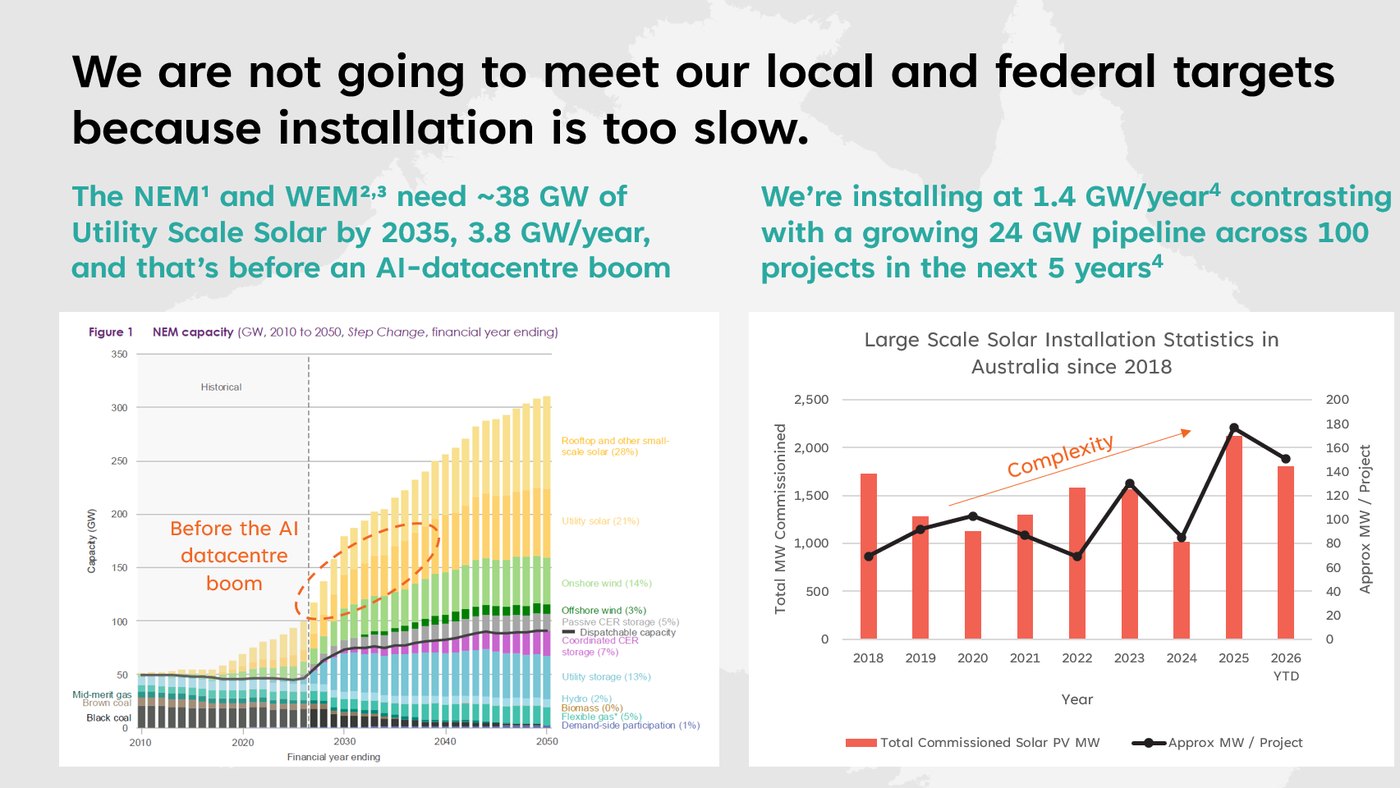
The shortfall isn't demand - it's execution. Across the industry, the same constraints show up again and again:
- Fragmented tools that don't talk to each other
- Manual workflows that delay and distort field data
- Poor visibility across project stages, from planning through to close-out
All of this adds time and cost to projects that are already running against a tight national timeline - and the complexity per project is only climbing as sites get larger and more technically demanding.
This is where digitising delivery changes the equation. Better project coordination leads to faster decisions, which lead to lower costs, which lead to more projects actually getting built. If the industry wants to hit its targets, the fix isn't just building more - it's fixing how we build.
At Surya, this is the problem we exist to solve: giving construction teams the real-time visibility they need to close the gap between what's planned and what's actually happening on site.
Sourced from AEMO's Generator Information page, individual WA and Pilbara solar project resources, and the 2026 Integrated System Plan.